


A Cathedral in the Heart of Des Moines
Since 1854, St. Paul’s has grown with Des Moines, standing as a Christian witness in the life of the city. Our story is one of worship, beauty, service, and welcome in the heart of downtown.
Our Story at a Glance
St. Paul’s history is woven into the history of Des Moines itself, from early services in the Polk County Courthouse to our life today as the cathedral church of the Diocese of Iowa.
St. Paul’s held its first Episcopal services in Des Moines at the Polk County Courthouse.
The first St. Paul’s church building was consecrated at Seventh and Walnut.
The present Gothic church opened for its first services on Easter Day.
St. Paul’s was designated the cathedral and liturgical center for the Diocese of Iowa.
St. Paul’s was honored by its addition to the National Register of Historic Places.
Humble Beginnings
St. Paul’s has grown with Des Moines, standing as a Christian witness in the life of our community for more than a century and a half.
The city was incorporated in January 1853, and St. Paul’s held its first services in October of the following year. Services were held at the Polk County Courthouse, sharing space on Sundays with several denominations on a first-come, first-served basis.
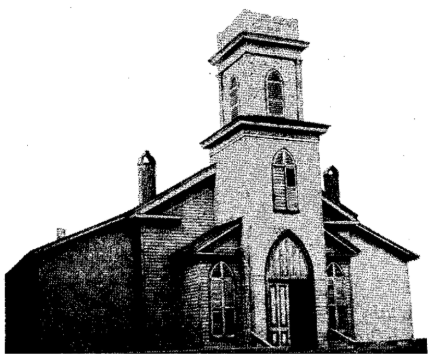
Just two years later, the first church building was erected at the corner of Seventh and Walnut. Consecrated in July 1857, it was a frame structure with a square bell tower over the entry.
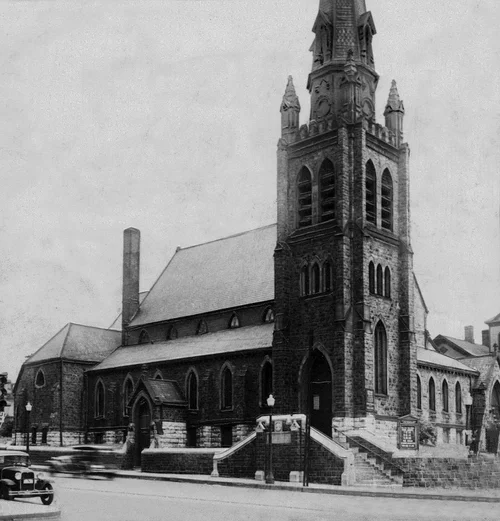
As the congregation grew out of the first building, the Vestry purchased two lots at Ninth Street and High Street. The local architectural firm of Foster and Liebbe was commissioned to design the church, and construction began in 1884.
The 1885 Building
Designed as a late Victorian Gothic church, virtually all windows and exterior door openings are Gothic arched, and the building is anchored to its setting by the corner bell tower topped with crenelated stone spires.
One marvels at the craftsmanship of the nineteenth-century stone carvers using their nineteenth-century tools. The lectern, pulpit, and marble baptismal font were moved into the new building, and the first services were held here on Easter 1885.
The central mass and features of the original 1885 design have remained basically unaltered since it was built. Later renovations and the consciously harmonious 1952 addition of the parish house have helped preserve and maintain the structure while supporting its life as the liturgical center of the parish and diocese.
Windows of Memory and Meaning
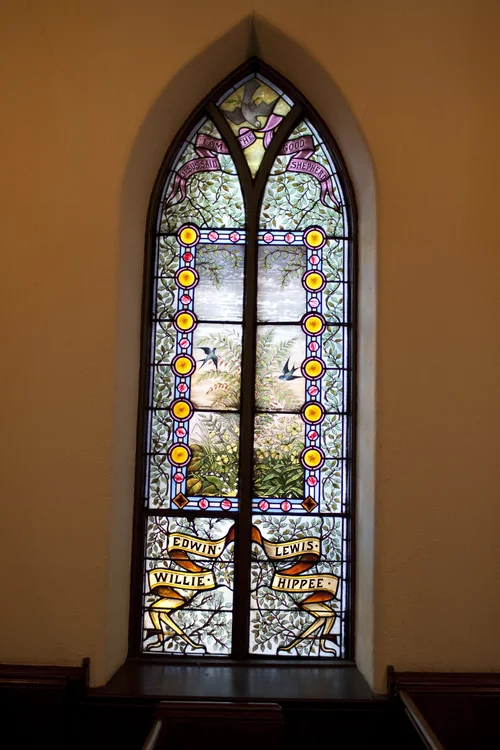
Inside the nave, the stained-glass windows are original. It is unusual that all of the memorial windows were completed within a year of construction, and also unusual that they were all provided by a single company, Groves & Steil of Philadelphia.
The commission has proven to be the firm’s most lasting legacy as the largest and last repository of work by one of Philadelphia’s successful nineteenth-century art glass firms.
The windows are fabricated in the then-popular Aesthetic Style. They combine stylized floral and foliage shapes with traditional Christian symbolism and the Victorian language of flowers, giving them multiple levels of meaning unified by repeating colors and motifs.
The memorial windows in the chancel, all commemorating bishops and clergy, were likely chosen by the rector, perhaps with input from the vestry, and possibly paid for out of the church building fund. Other windows were donated by numerous parishioners, including a widow of limited means, a clerk, a musical-instrument salesman, a hotel owner, and a real estate developer.
The eclectic design of the windows and their memorial quotations suggest that each person or couple who donated a window determined its content themselves, rather than having an overall program decided by clergy or the architect.
A Downtown Church on Piety Hill
When built, St. Paul’s was one of seven houses of worship from that period that stood in an area once known, jocularly but not irreverently, as “Piety Hill.”
With time, the other congregations left their downtown locations, moving west with the growing population of Des Moines. St. Paul’s remained.
That history can perhaps be characterized best by the cathedral’s commitment to ministry as a downtown church. Members have affirmed and reaffirmed their intent to remain at the present site as a vital hub in the life of the city and the Diocese of Iowa.

Cathedral Worship, Organ, and Carillon
Interior modifications in 1937, around the time of the building’s fiftieth anniversary, included the oak paneled walls in the choir and sanctuary and the installation of a neo-Gothic, carved wooden reredos.
Following St. Paul’s designation as the cathedral and liturgical center for the Diocese of Iowa in 1992, the chancel was refitted to include the cathedra, the bishop’s chair, and stalls for the dean and canons.
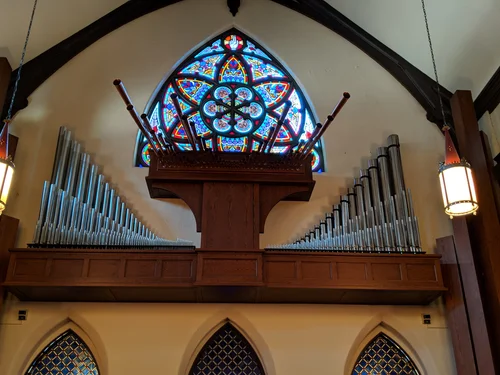
At this time, a new pipe organ was commissioned. The present instrument, Opus 3719 of Casavant Frères of Quebec, was installed the following year. It is one of the largest pipe organs in the state, with 3,916 pipes. The largest pipes weigh 500 pounds and stand thirty-two feet tall.
In addition to the organ, the bells in the carillon are another living embodiment of St. Paul’s musical heritage. The original chime was installed in 1896 and included eleven bells, rung by hand every Sunday for almost sixty years at a cost of $5 per month.
The chime was electrified in 1954, and in 1990 it was completely restored, retuned, and expanded to fourteen bells. In 1997, eleven more bells were added, bringing the total number to twenty-five, with a combined weight of 12,538 pounds.
Today, the carillon rings out over downtown Des Moines, offering music as a public gift and a sign of the cathedral’s presence in the city.
A Sacred Place for the City
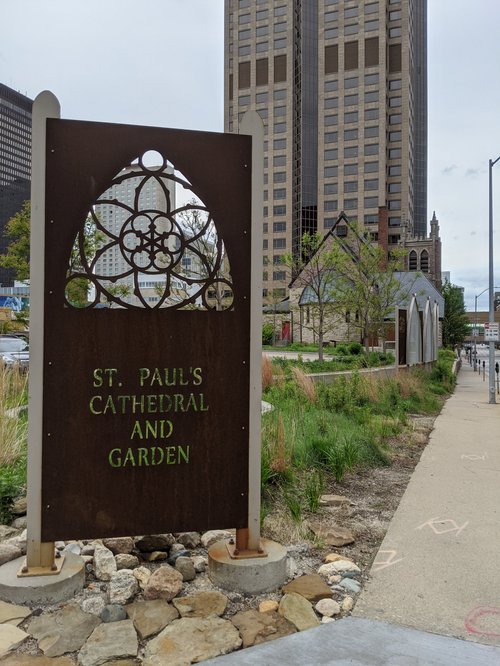
Unique to St. Paul’s location, and indeed to downtown Des Moines, is the labyrinth and rain garden, which replaced a decrepit asphalt parking lot on the north side of the church in 2011.
The new lot features permeable pavement for stormwater management and landscaping with native plants that do not require irrigation during periods of drought.
The labyrinth and rain garden are always open to the public, free of charge, offering a quiet place of prayer, reflection, and beauty in the heart of downtown.
In 2010, St. Paul’s was honored by its addition to the National Register of Historic Places.
Today’s parishioners represent a variety of socio-economic, educational, and vocational backgrounds, including members of varied racial and ethnic origins. St. Paul’s continually emphasizes that all are welcome within this oasis of sacred beauty in the heart of a twenty-first-century business district.
The story of St. Paul’s is not only about preserving the past. It is about carrying forward a living tradition of worship, beauty, service, and welcome for generations to come.